
ChatGPT for Sales: ChatGPT now reads your company's CRM
OpenAI connected ChatGPT to the CRM, meeting recordings and proposal tools. What ChatGPT for Sales does, who can use it and what to fix first.

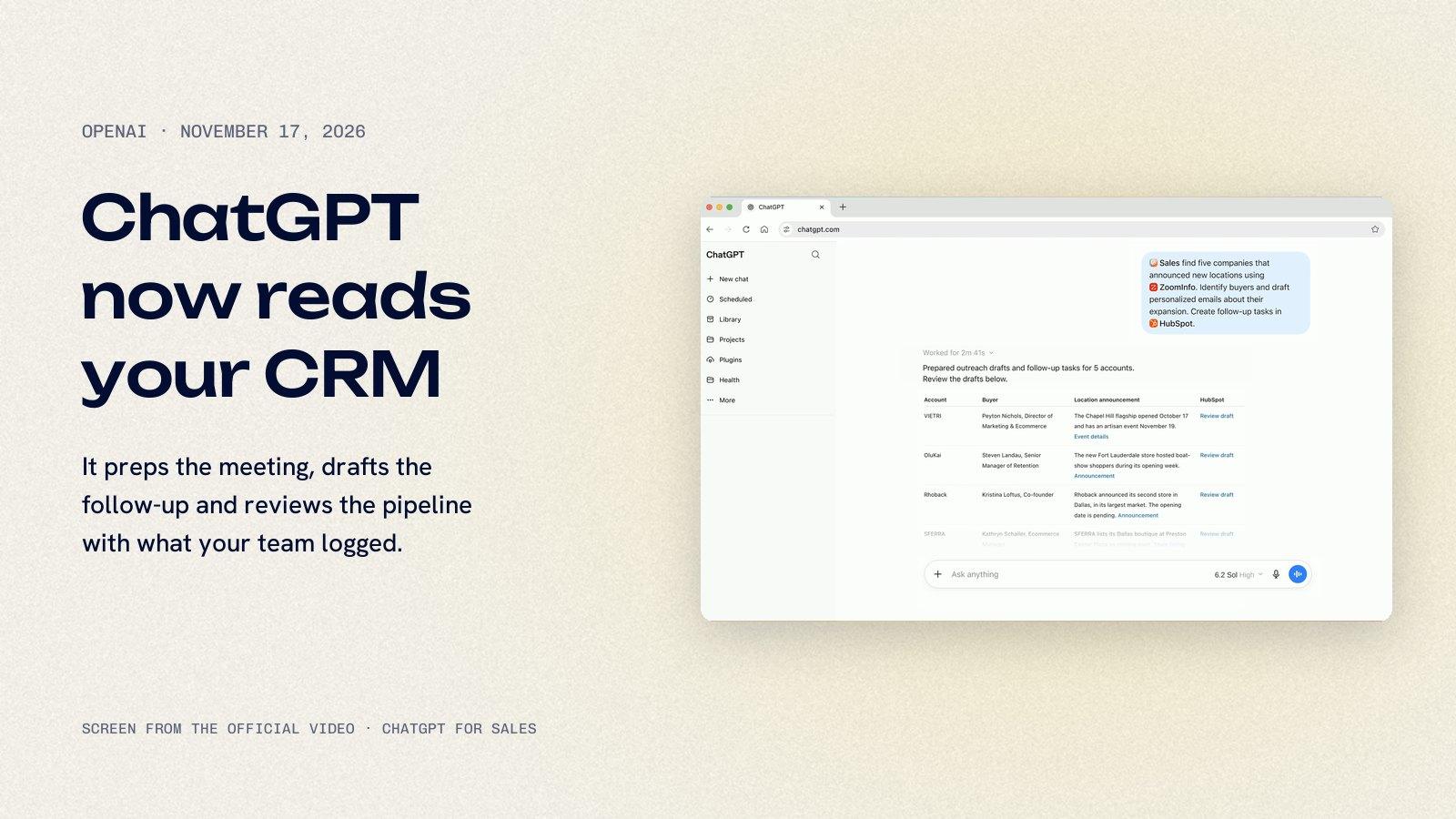
- On November 17, 2026, OpenAI launched ChatGPT for Sales: a Sales plugin and more than 30 new and enhanced partner plugins that connect ChatGPT to the CRM, meeting recordings and proposal tools.
- With the plugins connected, a seller asks and ChatGPT builds the account list, prepares the meeting with the customer's history, drafts the follow-up and points out the deals at risk in the pipeline.
- ChatGPT for Sales only works with what is logged in the connected tools: a negotiation that stayed on the seller's personal WhatsApp never makes it into the answer.
- Admins on the ChatGPT Business and Enterprise plans enable it for the team, and the availability of plugins varies by plan and region.
ChatGPT now reads the CRM. On November 17, 2026, OpenAI launched ChatGPT for Sales: a Sales plugin and more than 30 partner plugins that connect ChatGPT to the CRM, meeting recordings and proposal tools. For a team with its sales process in order, it saves time. For a team that sells over personal WhatsApp and updates the CRM when someone remembers, it is a mirror.
What ChatGPT for Sales is
There are two parts. The first is the Sales plugin built by OpenAI, with ready-to-use workflows for everyday work: deciding which accounts to pursue, preparing for a call and drafting the follow-up.
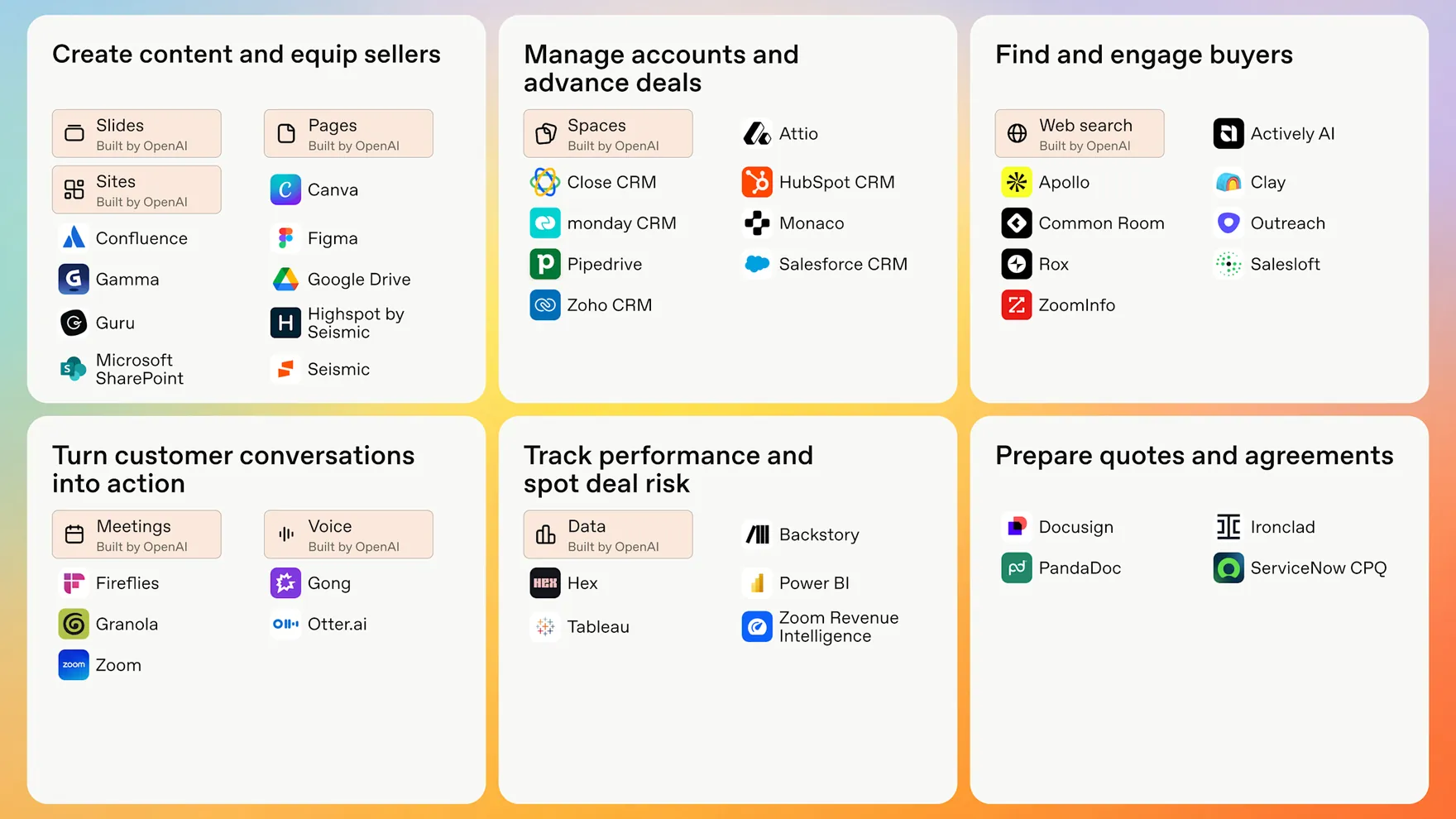
The second is the partner plugins, which bring data from the tools the team already uses into the conversation. OpenAI groups them by stage of the sale:
- Content and enablement. Confluence, Guru and Seismic for the sales process; Gamma, Figma and Canva for presentations.
- Accounts and deals. Salesforce, HubSpot, Close CRM and monday CRM to bring together each account's history.
- Prospecting. Apollo, Clay and Common Room, combined with ChatGPT's own web research.
- Customer conversations. Gong, Otter.ai and Granola, plus the Meetings plugin in ChatGPT.
- Performance and risk. Backstory and Hex to explain what changed in the pipeline.
- Quotes and agreements. Docusign, Ironclad, PandaDoc and ServiceNow CPQ.
What ChatGPT does with the CRM connected
The announcement describes four uses. In all of them, the seller asks in plain language and reviews the result before anything goes out.
- Builds the account list. It combines what is in the CRM with prospect research, explains why each account fits and points out missing information.
- Prepares the meeting. It brings account history, previous calls and the buyer's priorities into one briefing, and turns that into a pitch for that customer.
- Drafts the follow-up. After the call, it writes the message, captures the agreed next steps and proposes updates to the customer record. With some plugins, the next step is saved to the CRM from ChatGPT.
- Shows what is at risk. It explains what is holding up a deal, based on CRM history and customer conversations.
OpenAI also says work can keep moving between conversations with a "dot", an always-on agent in ChatGPT. An agent, here, is an AI assistant that carries out a task from start to finish. It uses the same plugins to prepare meeting briefs, track deals and bring changes to the seller for review.
Who can use it and how to turn it on
The admin turns it on. According to OpenAI, on the ChatGPT Business and Enterprise plans, the admin opens the Admin Console, selects the workspace and, under Plugins, makes the Sales plugin and the partner plugins available to the team, or installs them for everyone by default.
Before that, the admin reviews which apps each plugin can access and which actions it can take. After that, each person connects their own accounts when ChatGPT asks.
OpenAI notes that availability of plugins and features varies by plan, region and workspace settings. Check your own admin console before promising it to the team.
The limit: it only reads what the team logged
ChatGPT for Sales does not hear the call that was not recorded or read the message that stayed on the seller's phone. It works with what is in the connected tools.
In a company that sells through quotes and conversation, that changes the outcome. If a seller negotiates over personal WhatsApp and updates the CRM on Friday, the AI prepares Monday's meeting with last week's information. Well written, and just as confident.
An outdated CRM with AI on top delivers the mistake faster and better written.
The risk is not the tool failing. It is the tool working well on a record that does not reflect the sale. It is the same problem as when a salesperson leaves and the customer follows: the relationship lived with the person, not with the company.
What to fix in sales before turning the plugin on
Four questions show whether the team is ready:
- Is the customer conversation in the CRM or on the seller's phone? Without the conversation, the AI summarizes a contact record, not a negotiation.
- Does every open deal have a next step with a date? That is what ChatGPT uses to tell you what is stalled.
- Do the pipeline stages mean the same thing to everyone? If "proposal sent" means something different to each seller, the risk analysis comes out skewed.
- Who can turn on what? The admin decides which plugins come in and which data they can access. That is a company decision, not an individual one.
If the answer to the first two is "no", the work starts with the record, not with the plugin. Organized data comes before AI.
How Elev handles this in AI for Sales
In Elev's CRM, the AI is already connected. The team's WhatsApp lives inside the CRM, so the customer conversation is logged without depending on the seller's memory. On top of those conversations, the AI does three things:
- Reads the team's conversations. Each customer's history stays with the company.
- Tells the owner what is stalled. Alerts and findings arrive on the WhatsApp of the person who decides.
- Helps the seller with the follow-up. The reply starts from what has already been said to that customer.
Technology isn't what's missing. Context is. ChatGPT for Sales shows where the market is heading: AI inside the sales process, not in a tab next to it. The gain goes to whoever has the context on record.
That is Elev's work in AI for Sales: designing the process with the owner, getting the team onto the CRM and keeping the AI working on top of it. If you want AI in sales with context, talk to Elev.
Sources
- Introducing ChatGPT for Sales, OpenAI, November 17, 2026. The screens in this article come from the announcement and the launch video.
Frequently asked questions
What is ChatGPT for Sales?
It is the sales package OpenAI launched on November 17, 2026. It combines a Sales plugin built by OpenAI, with ready-to-use workflows for everyday sales work, and more than 30 new and enhanced partner plugins that bring data from the CRM, meetings and proposal tools into ChatGPT.
Which CRMs does ChatGPT for Sales work with?
In the announcement, OpenAI names Salesforce, HubSpot, Close CRM and monday CRM for bringing account context together. The official plugin overview also shows Attio, Pipedrive and Zoho CRM. Availability of each plugin varies by plan, region and workspace settings.
Who can use ChatGPT for Sales?
According to OpenAI, admins on the ChatGPT Business and Enterprise plans make the Sales plugin and the partner plugins available in the Admin Console, under Plugins. After that, each person connects their own accounts when ChatGPT asks.
Does ChatGPT for Sales replace the CRM?
No. It reads and summarizes what is in the CRM and the other connected tools, and with some plugins it saves the next step back. Logging the conversation, the deal and what was agreed with the customer is still the job of the CRM and the team.
Does ChatGPT for Sales read sellers' WhatsApp conversations?
Only if they are logged in a connected tool. What stays on a seller's personal WhatsApp never reaches ChatGPT. That is why the first step is to bring the customer conversation into the CRM.
Get the next articles.
One email when a new article is out. No sales sequence, no made-up schedule.
Published on November 19, 2026