
Your company doesn't need more AI. It needs organized data
AI on top of messy data just gets things wrong faster. What AI-ready data is, why most companies don't have it, and where to start.

- Most companies start using AI by choosing the tool, when what decides the result is the quality of the data the tool will read.
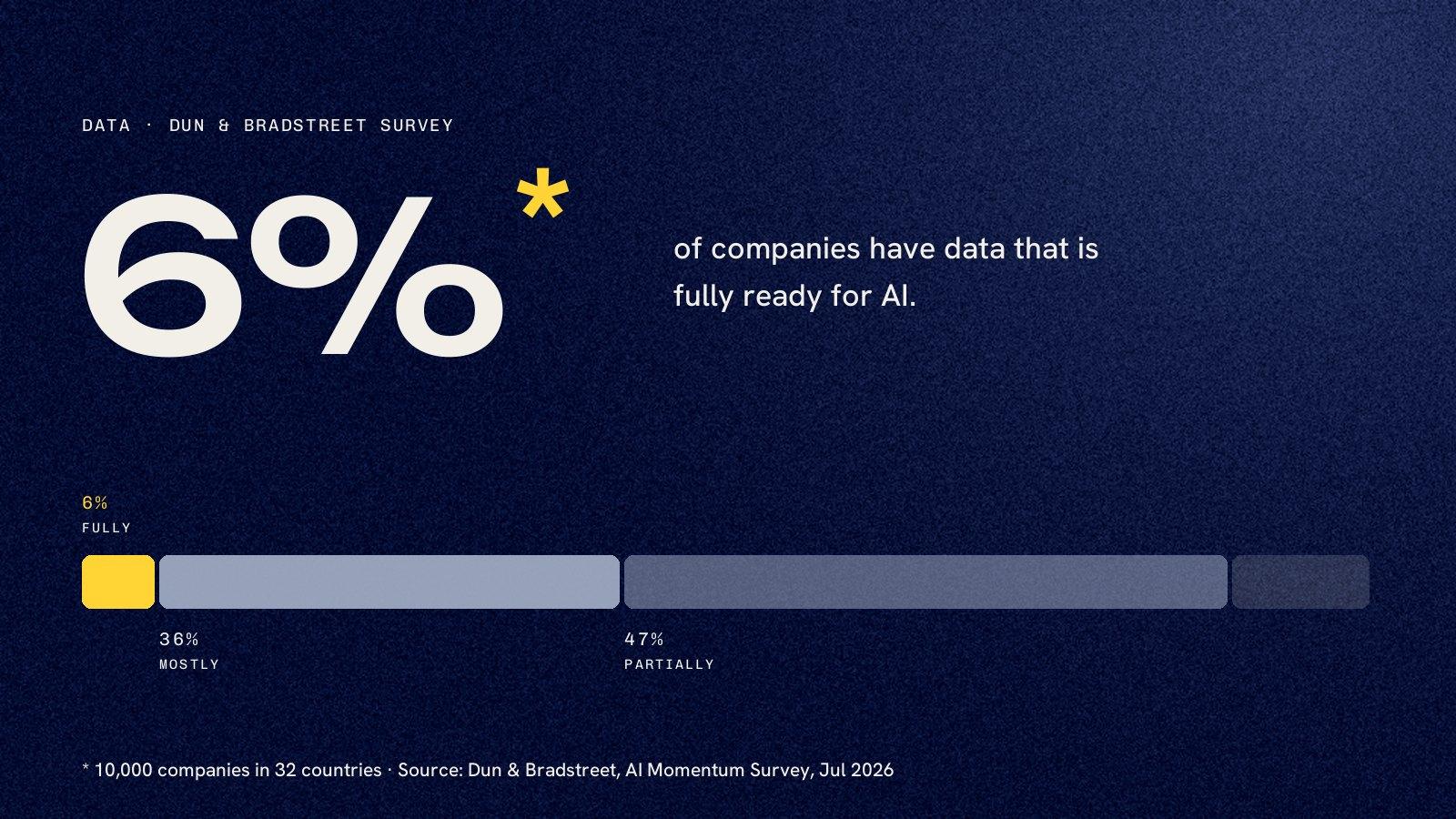
- Only 6% of companies say their data is fully AI-ready, according to a Dun & Bradstreet survey of 10,000 companies in 32 countries, released in July 2026.
- Gartner predicts that 60% of AI projects without prepared data will be abandoned by the end of 2026.
- AI-ready data comes down to four things: up-to-date documents, customer history in one place, written rules and systems that talk to each other.
The question we hear most from business owners is "which AI should I use?". Almost always, the right question is a different one: "what will the AI read when I start using it?".
The answer decides whether the project pays off or becomes one more forgotten subscription. A good AI on top of messy data does not solve the problem. It just gets things wrong faster.
AI has already reached Brazilian companies
Adoption is growing fast. According to the TIC Empresas 2025 survey by Cetic.br, a Brazilian research center on technology use, released in June 2026, the share of Brazilian companies using AI rose from 13% to 17% in one year. Among large companies, the figure reaches 50%. Among small ones, with 10 to 49 employees, it is 15%.
The distance between the two groups grew: it was 28 points and is now 35. Large companies are adopting faster.
The use that grew the most was text generation, which went from 20% to 30% among the companies that use AI. It is the most visible use: answering customers, writing proposals, summarizing documents. It is also the one that depends most on the AI knowing the company.
Using AI is not the same as getting results
International surveys show the same pattern: a lot of adoption and little measured return. And the reason cited most often is not the model.
- Only 6% have AI-ready data. In the Dun & Bradstreet survey of 10,000 companies in 32 countries, released in July 2026, only 6% said their data was fully AI-ready.
- 60% of projects without prepared data will be abandoned. That is Gartner's prediction, published in February 2025, for AI projects running on unprepared data through the end of 2026.
- A quarter of the data is not trustworthy. The data leaders surveyed by Salesforce in 2025, 7,652 people in 18 countries, estimate that 26% of their own companies' data is untrustworthy. And 84% say the data strategy needs to be overhauled before AI can succeed.
The difference between companies will not be in the model they use. It will be in what the model knows about them.
What data AI can actually read looks like
You do not need a data project that costs millions. For a small or midsize company, AI-ready data comes down to four things:
- Up-to-date documents. Price list, return policy, contract templates, frequently asked questions. One version of each, the current one, in a known place.
- Customer history in one place. Who bought, what they asked for, what was agreed. In a system, not in each salesperson's WhatsApp.
- Written rules. What discount can be given, when an order becomes urgent, who approves what. If the rule exists only in the manager's head, AI has no way to follow it.
- Systems that talk to each other. When the CRM, the ERP and the calendar are not connected, information is copied by hand, and every copy is a chance for a mismatch. AI reads the wrong version without knowing it is wrong.
If a new hire would take weeks to find this information, AI will not find it either.
Why small companies start from the wrong end
Because signing up for an AI tool is so easy, many companies started by choosing the platform. It is the fastest path and the most frustrating one.
A survey by Sebrae (Brazil's small business support agency) with FGV Ibre and Google, released in January 2026, shows that 15% of Brazilian micro and small businesses use AI frequently, compared with 35% of midsize and large ones. The main barrier named was not the price. It was not knowing how to apply it.
In practice, the sequence that works is the reverse: first the data, then the process, then the AI.
Where to start
- Pick one process. Customer service, quoting, collections or scheduling. Just one.
- Map where each piece of information it uses lives. Spreadsheet, system, email, phone, someone's head. Write it all down.
- Define one official source for each piece of information. One place for the price, one for the customer, one for the order. Everything else is a copy.
- Connect the systems that repeat each other. If someone types the same thing in two places, that is where integration pays for itself.
- Only then put AI to work. With reliable data underneath, it starts answering about your company, not in general terms.
- Keep it up. Prices change, rules change, systems get updated. Data that is organized once and forgotten goes back to being messy data within a few months.
This is the work Elev does before any AI agent: organizing customer history in a CRM, connecting the systems the operation already uses and keeping everything up to date. If you want to know how much AI can know about your company today, talk to us.
Sources
- TIC Empresas 2025: AI use by Brazilian companies reaches 17% (in Portuguese), Cetic.br/NIC.br, June 2026.
- AI Momentum Survey, Dun & Bradstreet, July 2026.
- Lack of AI-Ready Data Puts AI Projects at Risk, Gartner, February 2025.
- State of Data and Analytics, Salesforce, November 2025.
- Small businesses embrace artificial intelligence (in Portuguese), Agência Sebrae, January 2026.
Frequently asked questions
What is AI-ready data?
AI-ready data is company information that AI can find, understand and trust: up-to-date documents, customer history recorded in a system, written business rules and connected systems. If the information sits on someone's phone, in a side spreadsheet or in an employee's head, it is not AI-ready.
Do I need to organize all of my company's data before using AI?
No. The safest path is to pick one process, such as customer service, quoting or collections, and organize only the data that process uses. Once that process works, you move on to the next one.
Why does AI give wrong answers about my company?
Almost always because it was not given the right information. Without access to your documents, prices and rules, AI answers with what it knows in general terms. With access to old or contradictory data, it confidently tells you something that is no longer true.
Can a small business use AI in a useful way?
Yes, and often faster than large companies, because it has fewer systems to organize. According to Sebrae, Brazil's small business support agency, what holds small businesses back is not the price: it is not knowing how to apply AI.
What is the first step to organizing a company's data?
Map where each important piece of information lives today: customers, prices, orders, contracts, rules. The map shows what is scattered, what is duplicated and what exists only in someone's head. It is the starting point for deciding what to organize first.
Get the next articles.
One email when a new article is out. No sales sequence, no made-up schedule.
Published on September 23, 2026