
When a salesperson leaves, the customer follows. How to prevent it
If customer history lives in each sales rep's WhatsApp, it leaves with the rep. How to keep your accounts in the company with a CRM the team uses.

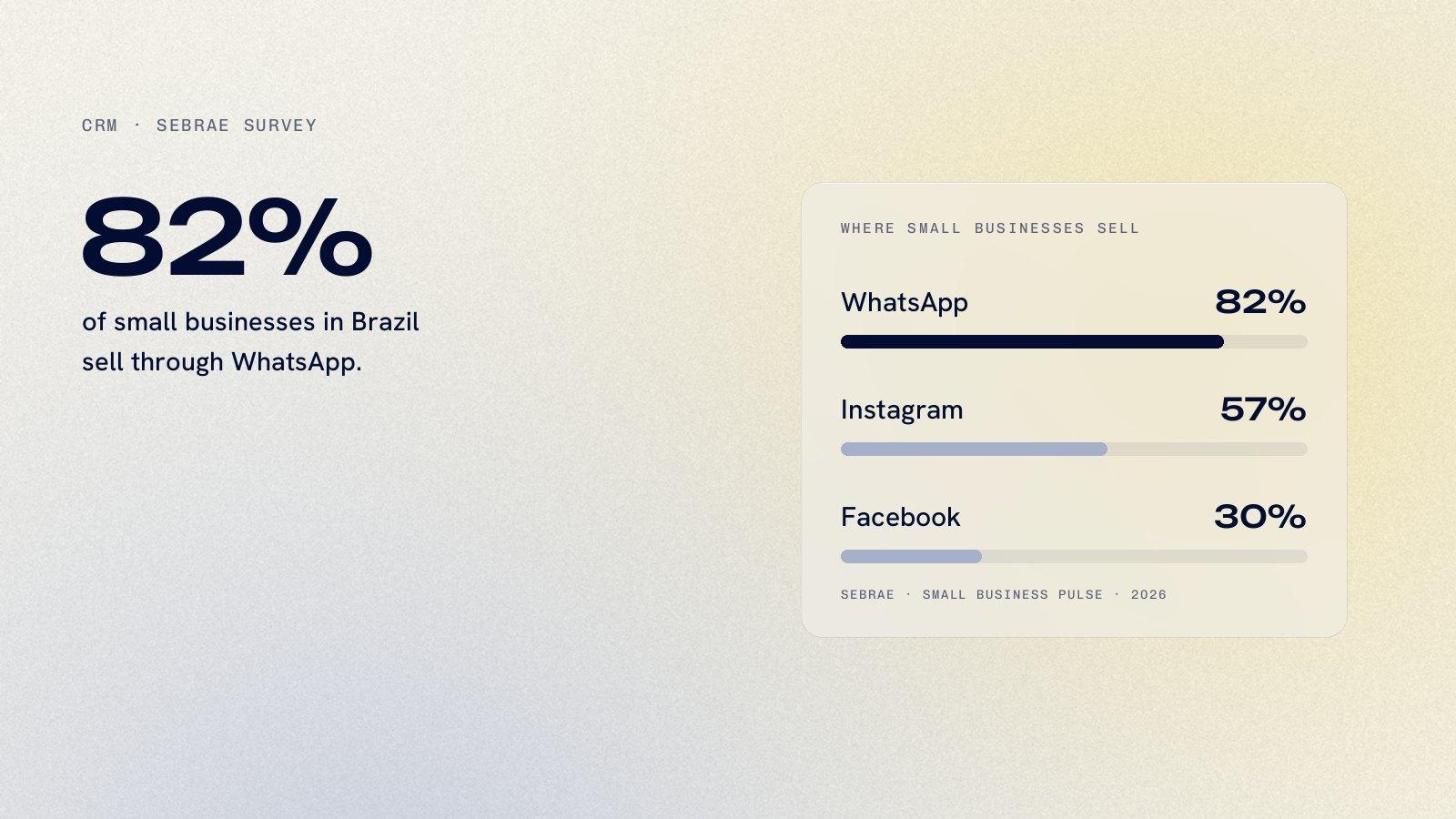
- In a large share of Brazilian small businesses, each customer's history lives in the salesperson's WhatsApp, and it walks out the door when the salesperson leaves.
- 82% of small businesses in Brazil sell through WhatsApp, according to Sebrae, Brazil's small business support agency, which makes the problem nearly universal there.
- Under Brazil's General Data Protection Law (LGPD), customer data is the company's responsibility, even when it sits on an employee's phone.
- A CRM solves this only when the team uses it: implementation, training and ongoing support matter more than which system you choose.
A salesperson leaves the company. The following week, someone realizes that nobody knows where his deals stood. The quotes sent, the discounts agreed and the conversations with each customer were in the WhatsApp on his phone. And the phone left with him.
It is one of the most common problems in Brazilian small and midsize companies, and one of the easiest to avoid.
Customer history cannot live on someone's phone
WhatsApp has become the front counter of the Brazilian company. According to Sebrae (Brazil's small business support agency), 82% of small businesses sell through the app, well ahead of Instagram, at 57%.
The problem is not using WhatsApp. It is what happens when each salesperson works from their own number. The conversation with the customer, the quote in PDF, the product photo, the "I'll send you the price tomorrow". All of it stays on a device that does not belong to the company.
While the person is on the team, it seems to work. When they leave, the company finds out it does not know who their customers are.
A book of business that exists only on the salesperson's phone belongs to the salesperson, not to the company.
High turnover makes this inevitable
Salespeople change jobs often. In retail in the city of São Paulo, turnover reached 60.3% in 2025, the highest since 2020, according to a survey by Sindilojas-SP (the São Paulo retailers' association) based on data from Novo Caged, Brazil's formal employment registry. In the first half of 2026, it was the highest for the period in seven years.
At that pace, the question is not whether someone will leave, but when. Every departure without recorded history turns into forgotten customers, deals that go cold and proposals redone from scratch.
Customer data is the company's responsibility
There is also a legal point. Under Brazil's General Data Protection Law (LGPD), the one who answers for customer data is the company, not the employee. The guide on data processing agents from ANPD (Brazil's data protection authority) is clear: the employee acts under the company's direction, and it is the company that answers to the customer and to the authority.
In practice, this means the company is responsible for data sitting on a device it does not control, one that can be lost, stolen or taken to a competitor.
Why so many companies have a CRM and don't use it
The well-known solution is a CRM: a system where every contact, conversation and deal is recorded in the company's name. Many companies have tried, and many gave up.
The reason is rarely the system. It is what happens around it:
- The system arrives empty. No contacts imported, no sales stages designed, no channels connected. The salesperson opens it, finds nothing and goes back to WhatsApp.
- Logging takes more work than selling. If the salesperson has to copy the conversation from the phone into the CRM, they will not copy it. The channels need to be inside the system.
- Nobody trained the team. Each role uses the system differently. Without training on the real routine, everyone makes up their own way, and the data becomes useless.
- Nobody adjusts it afterward. The operation changes, the pipeline changes, a new channel shows up. Without someone looking after it, the CRM stops reflecting reality and the team stops trusting it.
The lack of care is expensive. In Validity's 2025 survey of 602 CRM users, 76% said that less than half of the data in the system was accurate and complete, and 37% said they had lost revenue because of bad data.
How to keep the book of business in the company
- Put the channels inside the CRM. WhatsApp, Instagram, email. The customer talks to the company, and the conversation is recorded without anyone copying anything.
- Use company numbers, not personal ones. When someone leaves, the number and the history stay.
- Import what already exists. Contacts, history and deals in progress go into the system from day one.
- Design the pipeline with the team. The stages in the CRM need to be the real stages of the sale, with the names the team uses.
- Train each role on its own routine. Salesperson, customer service and manager use the system in different ways.
- Have someone looking after it. Adjusting automations, answering questions and checking whether the system is being used. That is what keeps the CRM from turning into a dead contact list.
When the next salesperson leaves, whoever takes over the accounts opens the CRM and finds everything: what was discussed, what was promised and the next step for each customer.
This is how Elev works with CRM and sales operations: we implement the system with your operation built in, connect the channels, train the team and stay on support every month. If your customer history is still scattered across phones, talk to us.
Sources
- WhatsApp consolidates its place in online sales (in Portuguese), Agência Sebrae, Pulso dos Pequenos Negócios, 2026.
- Turnover at São Paulo retail companies hits a record in 2025 (in Portuguese), Sindilojas-SP.
- Turnover in São Paulo's labor market hits a record in the first half of 2026 (in Portuguese), August 2026.
- Guidance on personal data processing agents (in Portuguese), ANPD.
- State of CRM Data Management in 2025, Validity, July 2025.
Frequently asked questions
How do I avoid losing customers when a salesperson leaves the company?
By recording every contact in a company system from day one, not on the personal phone of whoever handles the customer. With the history in the CRM, whoever takes over the accounts knows what was discussed, what was promised and where each deal stands.
Who owns the customer contacts a salesperson keeps on their phone?
The data of customers served on the company's behalf is the company's responsibility. Under Brazil's General Data Protection Law (LGPD), the employee acts under the company's direction, and the company answers for how that data is handled before the customer and ANPD, Brazil's data protection authority.
Why doesn't my sales team use the CRM?
Because, most of the time, the team was handed an empty system, without its routine built in and without training. If logging in the CRM takes more work than replying on WhatsApp, the salesperson goes back to WhatsApp. The CRM has to make the seller's day easier, not just give the manager numbers.
Can I use the company's WhatsApp inside the CRM?
Yes. Most current CRMs bring WhatsApp, Instagram, email and other channels together in one place, with each customer's history alongside. The number then belongs to the company, not to the person.
How long does it take to implement a CRM?
It depends on the size of the operation, but what sets the timeline is rarely the system. It is importing the contacts and history, designing the sales stages and training the team. Without those three things, the CRM is ready on paper and empty in practice.
Get the next articles.
One email when a new article is out. No sales sequence, no made-up schedule.
Published on September 23, 2026