
Where AI fits in the org chart, according to an OpenAI essay
Two OpenAI researchers describe three places for AI in a company: beneath, beside and between people. What that changes and what to prepare now.

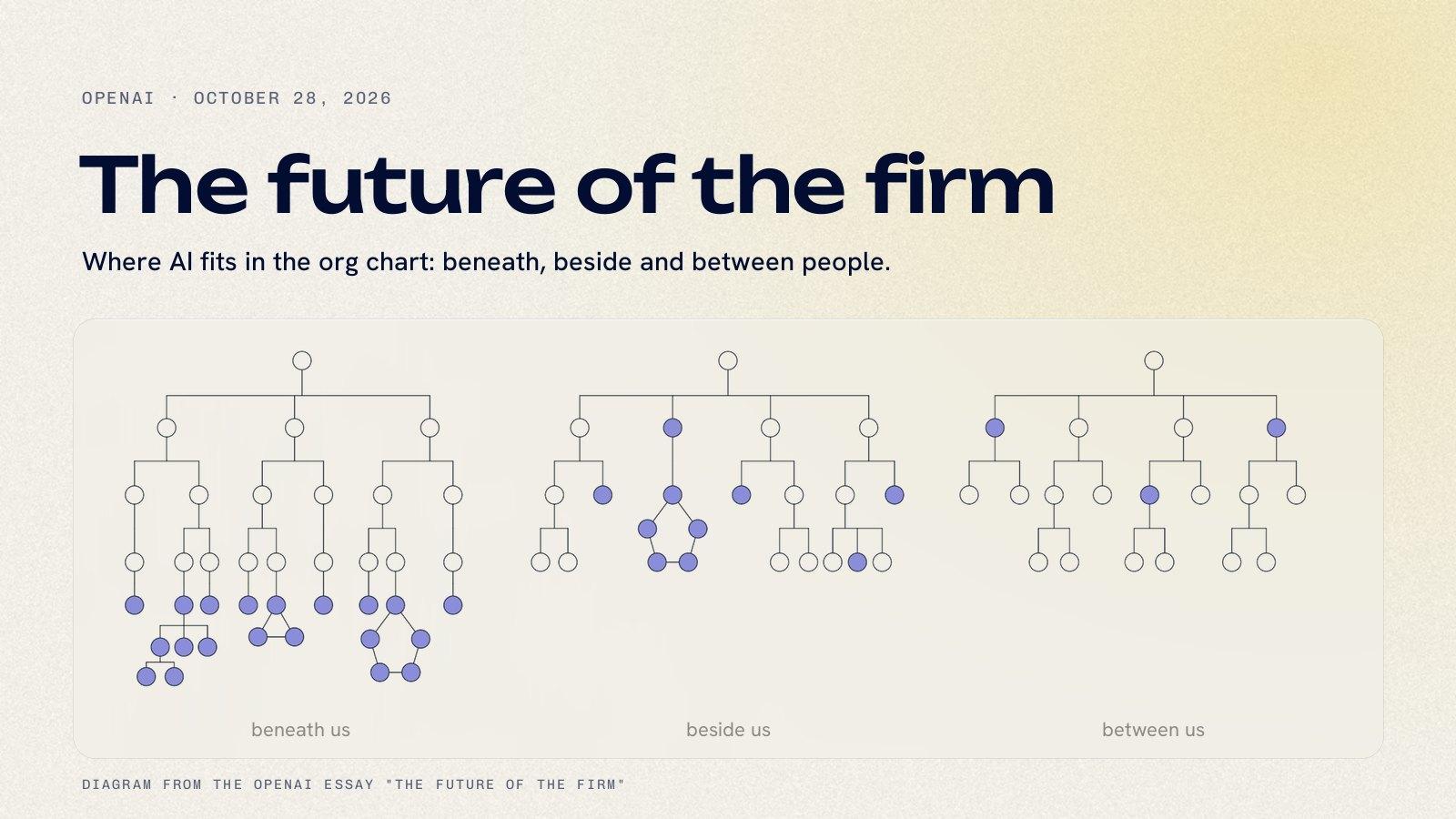
- In the essay "The future of the firm," published by OpenAI on October 28, 2026, two of the company's researchers describe three places where AI enters the org chart: beneath people, beside them and between them.
- The central thesis is that AI capable of taking on bigger scope is harder to build but easier for a company to adopt.
- The authors point out that a company learns a technology, but a good employee learns the company: the more AI absorbs the context of the business, the more useful it becomes.
- In their view, some management functions may be automated before the work they oversee.
On October 28, OpenAI published the essay "The future of the firm," by Hemanth Asirvatham and Elliott Mokski. The question is simple: when AI enters a company, where does it go in the org chart? Their answer has three places, and one of them runs against what almost everyone imagines.
The essay is part of a series in which OpenAI publishes independent voices on the next economy. The authors themselves note that it reflects their views, not the company's.
AI beneath people: everyone becomes a manager
In the first scenario, everyone keeps their seat. Each person gets, underneath them, a team of AI agents (AI assistants that carry out a task from start to finish). At first they are like interns who need supervision. Over time, they take on more tasks and start working with each other.
The essay's example is Jace, an accountant. He still does the accounting, but he is no longer clicking around spreadsheets: the agents do that. His job becomes more like his manager's from a few years ago. The team has not shrunk, because the rest of the company has become more productive too and demands more accounting than before.
The authors call this automating "our past selves." AI takes on what the person used to do, and the person moves up a rung.
AI beside people: an entire function taken over
In the second scenario, AI joins as a teammate and reports to the same manager as the people do. The difference is that the one who adopts it is not the person who does the work, but the manager.
The example is Sheila, a VP at a furniture company, who has never run an ad campaign. She gives an AI marketing team a budget and a new sofa to sell. The agents divide the work among themselves, talk to the salespeople, check with the factory what can actually be delivered and test visual styles. On Monday, she is handed the finished campaign to approve.
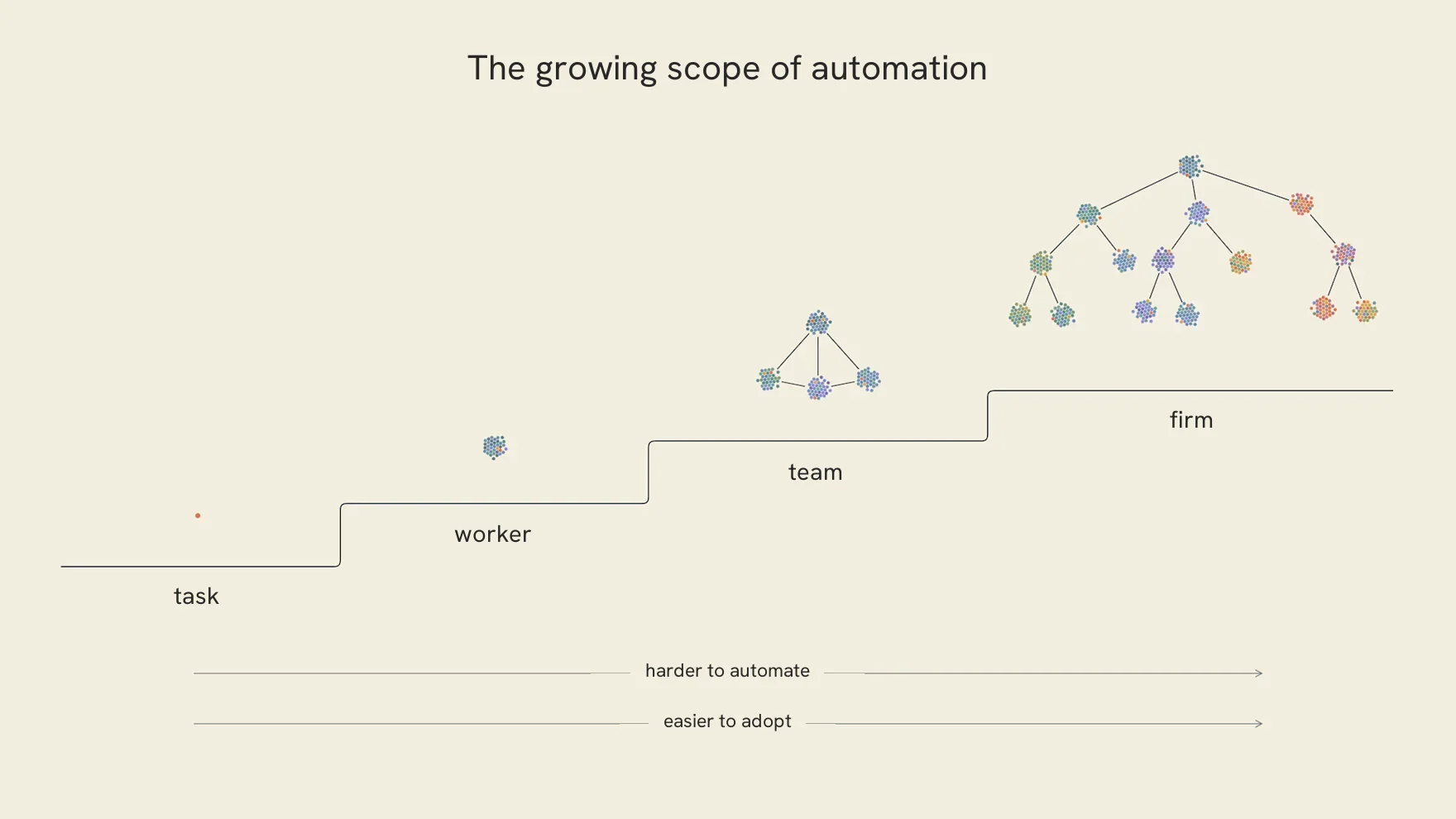
Here is the essay's central idea. AI climbs a staircase: first it automates a task, then a person's job, then a team's and, finally, a firm's. Each step is harder to build. But for the company, each step is easier to adopt. A tool that does only one task depends on everyone learning to use it. An AI team that delivers the whole function, the VP adopts with a single decision.
Firms learn technology; labor learns the firm
This is the part of the essay I consider most important. Every new technology forces the company to adapt to it: the spreadsheet did not install itself in the accounting department, the department reorganized itself around it.
With people it is the opposite. A good intern or a good team figures out how to be useful to you. They ask questions, absorb your context, notice what you need and even tell you what you didn't realize you didn't know. For the authors, the more AI works like this, the less the company has to learn how to use it and the more it adapts to the company.
AI is only truly useful when it knows the company it works in.
In practice, this means AI needs to find the context of the business: processes, customers, rules, history. Without that, it does not fit into any of the three places in the org chart.
AI between people: management may be automated first
The third scenario is the least intuitive. AI sits above some people and below others. The example is Asha, a chief executive, who gets an alert from her AI consultancy: sales promised the customer a feature that engineering is not building. Nobody wrote anything up or noticed the gap; the AI found the problem in everyday work conversations. It also notices that an engineer had already started working on the issue without being asked, and Asha puts her in charge of the project.
From there comes the essay's most provocative line: the ladder might burn from the top. We tend to assume AI starts with the simplest tasks and reaches management last. But much of a manager's work happens on a computer and in the mind: reading, gathering information, weighing and deciding. It is the intern who gets sent to the photocopier, not the boss. That is why, according to the authors, some management functions may be automated before the work they oversee.
What AI changes in companies, according to the OpenAI essay
The authors close with four open questions. Three of them directly affect anyone who runs a company:
- Less red tape. Many approval steps exist because building was expensive and there was only one shot. With AI making prototypes cheaper, the company can test more and plan less.
- A different first job. The lowest rung is no longer filled by people. New hires already coordinate agents, with more room to show ideas and less learning that comes from repetitive work.
- Judgment as the differentiator. If AI gives the same good advice to everyone, what sets people apart is the quality of their decisions. The larger the work each person coordinates, the more that difference shows.
What to do in your company so AI can enter the org chart
None of the three scenarios happens without context. AI that sits beneath people needs to know how the work is done. AI that sits beside them needs to know the product, the customer and the rules. AI that sits between people needs access to the conversations and the systems to see what is going on.
Three things prepare a company for any of them:
- Information in one place. Processes, customers, contracts and decisions on record, not scattered across conversations and people's heads.
- Connected systems. CRM, email, finance and customer service linked, with data that matches from one to the other.
- Clear rules for what AI can do on its own. What it handles, what needs your yes and what it never does.
Technology isn't what's missing. Context is. That is Elev's work in Company AI and AI for Operations: organizing the information, connecting the systems and defining the usage policy so AI works with the context of your business. If you want to understand where AI enters your operation first, start here.
Sources
- The future of the firm, Hemanth Asirvatham and Elliott Mokski, OpenAI, October 28, 2026. The charts in this post come from the essay, adapted by Elev.
Frequently asked questions
What does OpenAI's essay "The future of the firm" say?
Written by Hemanth Asirvatham and Elliott Mokski and published by OpenAI on October 28, 2026, it describes three ways AI can enter a company (beneath, beside and between people) and discusses what that changes for red tape, worker agency, firm size and pay. It reflects the authors' views, not an official OpenAI position.
Will AI replace managers?
The essay does not say that. It raises the hypothesis that some management functions (reading, gathering information, keeping track of what each team is doing and alerting leadership) may be automated before ground-level work. The decision stays with people.
Where should a company start using AI?
According to the authors, adoption tends to start with the people who do the work, because they are the ones who know how it is done. In practice, this works better when the company's information is organized and there are clear rules for what AI can do on its own.
What changes for people starting their careers?
In the authors' view, the lowest rung of the company is no longer filled by people. New hires already coordinate AI agents and need to develop judgment, taste and vision earlier. The authors acknowledge that part of the learning that came from repetitive work is lost.
Get the next articles.
One email when a new article is out. No sales sequence, no made-up schedule.
Published on October 29, 2026