
Claude Opus 5.5 is here: what changes for people using AI at work
Anthropic's new model delivers top-of-the-line results for about 40% less and writes more clearly. Comparison, cost without jargon and when to use it.

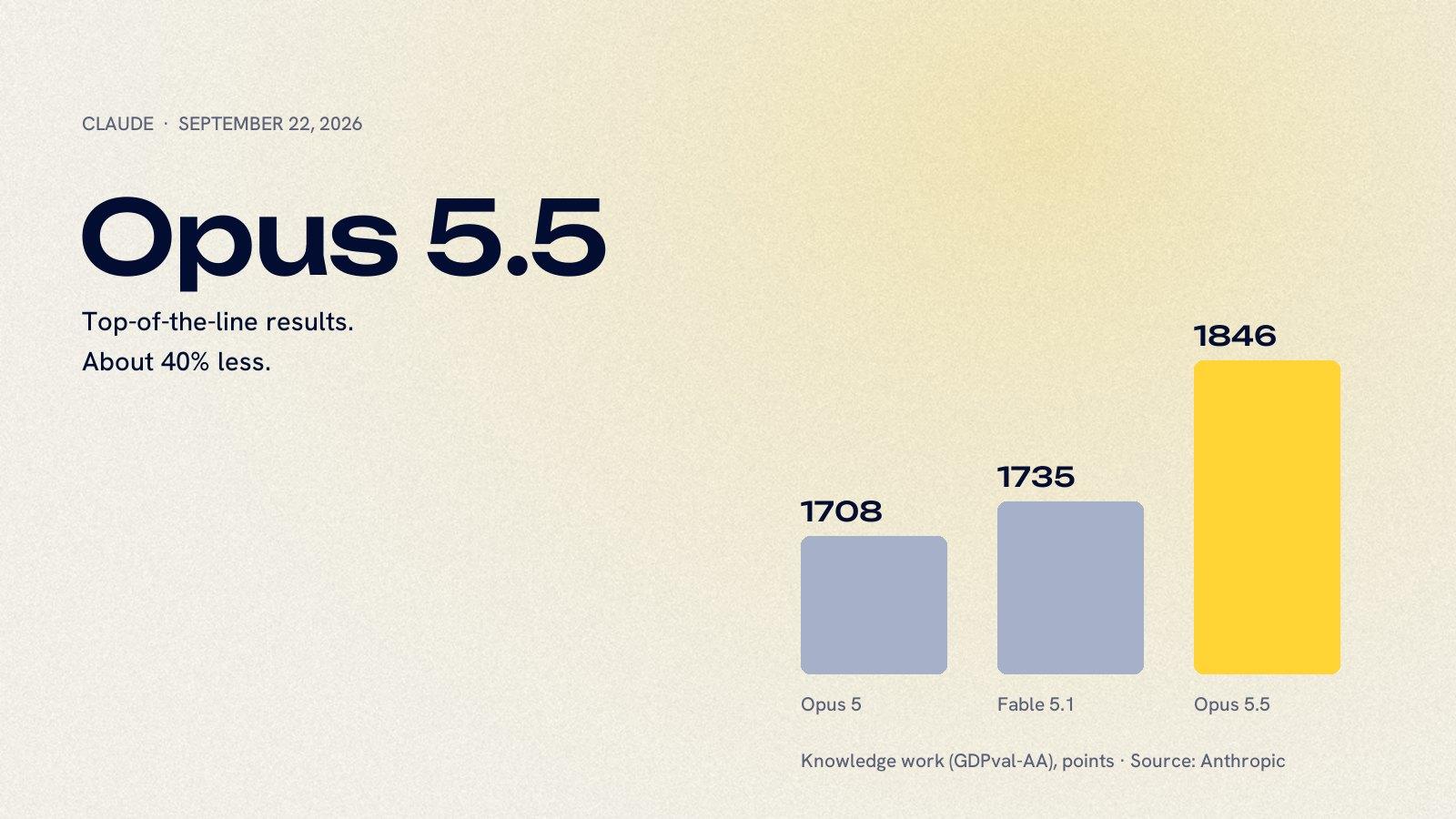
- Claude Opus 5.5, released on September 22, 2026, delivers the results of Anthropic's top-of-the-line model for about 40% less.
- For people who use Claude in the app, the change they notice most in Opus 5.5 is the writing: clearer, shorter answers with what matters first.
- For companies running AI agents, Claude Opus 5.5 does the same task in fewer steps, which cuts cost and waiting time.
- Claude Opus 5.5 is not for everything: simple, high-volume tasks are still cheaper on Haiku and Sonnet.
Anthropic released Claude Opus 5.5 today, the first model in the Claude 5.5 family. It is not a "slightly better" version. It is a model that delivers what only the top of the line used to deliver, for less money, and that writes in a way that is easier to read.
This post is for people who use AI at work without writing code: those who chat with Claude, those who have an agent serving customers, those who pay the bill at the end of the month. We leave the jargon aside and stick to what changes in practice.
What changed, in plain language
Three things matter if you are not a developer.
It writes better. Anthropic says Opus 5.5 puts the most important information first, uses less jargon and answers in a shorter, more organized way. Box, a document management company, measured answers that were 40% leaner without losing accuracy. For anyone who reads dozens of answers a day, that is time.
It does the same task in fewer steps. When an AI agent carries out a job, it takes several steps: it reads, decides, uses a tool, checks, repeats. Opus 5.5 gets to the same result in fewer steps. Optiver, a financial markets firm, said it got the same quality as Opus 5 in about half the time, with a bill 40% to 50% lower.
It makes fewer mistakes and oversteps less. In Anthropic's tests, the model tries to get around limits 85% less often than Opus 5, is better at resisting malicious instructions hidden in documents and avoids actions that are hard to undo. For anyone with an agent that has access to the company's CRM or email, this is what matters.
The gain is not in doing new things. It is in doing the same things with fewer steps and fewer mistakes.
How Claude Opus 5.5 compares
Anthropic published the comparison below. The columns are Opus 5.5, Fable 5.1 (Anthropic's most expensive model), Opus 5 (the previous one) and two OpenAI models.
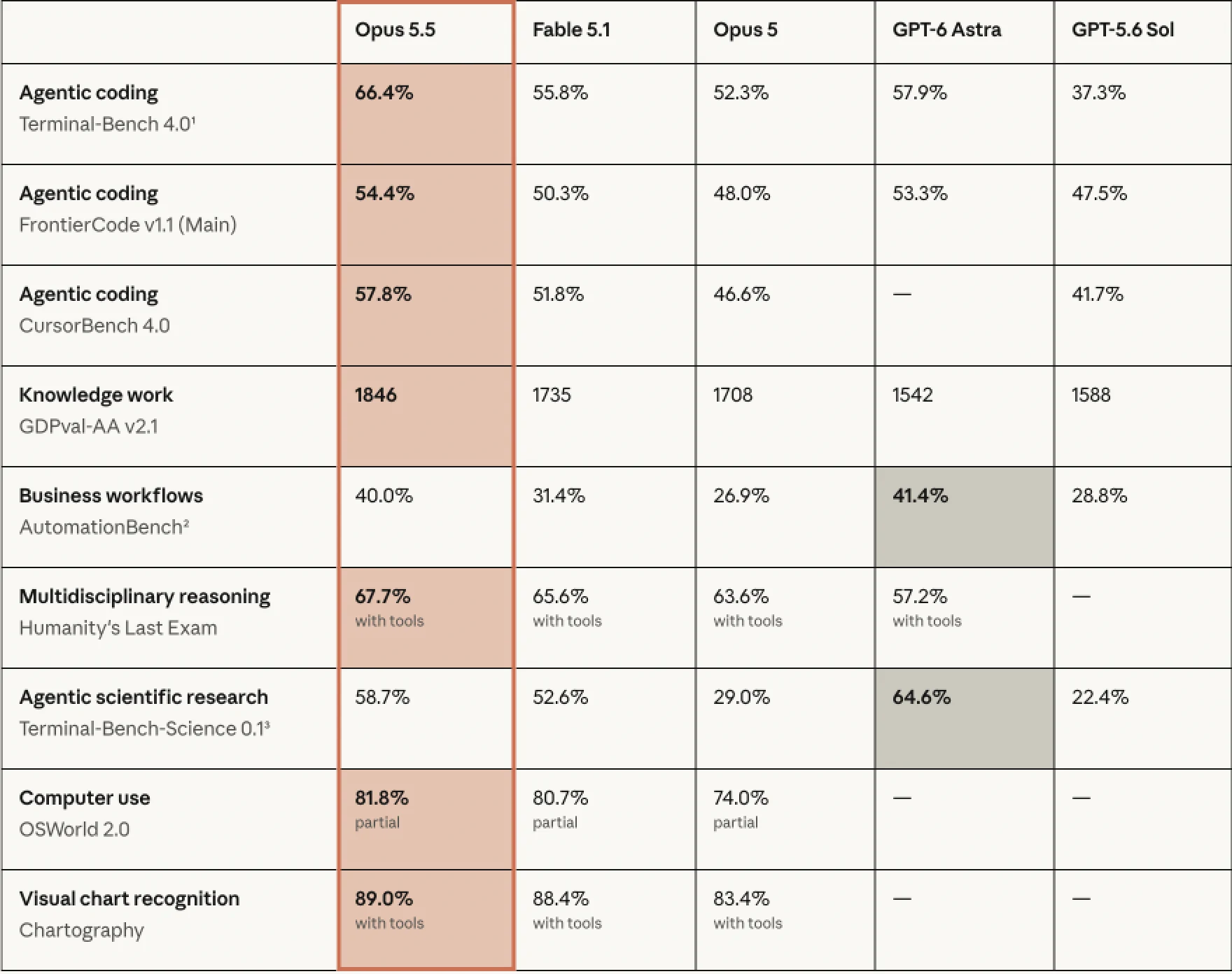
The test names are technical. Here is what each row measures, in plain English:
| Table row | What it measures in practice |
|---|---|
| Agentic coding (three rows) | Writing code on its own, from the start to the end of a task |
| Knowledge work | Office work: reports, analyses, documents. The higher the number, the better |
| Business workflows | Running a business process end to end, with several stages |
| Multidisciplinary reasoning | Reasoning through hard questions from several fields |
| Agentic scientific research | Conducting scientific research autonomously |
| Computer use | Using a computer the way a person does: opening systems, clicking, filling in fields |
| Visual chart recognition | Reading charts and images |
The point to notice: on seven of the nine rows, Opus 5.5 beats Fable 5.1, which costs more than twice as much. That is why Anthropic positions it as the default model for long work. On the two rows it loses, to the OpenAI model, the gap is in business processes and scientific research.
How much Claude Opus 5.5 costs
Here it helps to separate two worlds.
People who use Claude through the app do not see model pricing. They pay the subscription and pick Opus 5.5 in the model selector. At launch, the Pro, Max and Team plans got higher usage limits.
Companies with agents running pay by the volume of text the model reads and writes. A typical conversation costs cents; what adds up is scale, an agent that serves a thousand people a day. In that world, what matters is how much each model costs relative to the others for the same work:
| Model | What it is for | Cost for the same work | Speed |
|---|---|---|---|
| Claude Fable 5.1 | Maximum capability | 2.5 times Opus 5.5 | Slower |
| Claude Opus 5.5 | Long, hard tasks, agents | baseline | Moderate |
| Claude Sonnet 5 | Day-to-day work at most companies | half | Fast |
| Claude Haiku 4.5 | Volume: triage, classification, summaries | a quarter | The fastest |
Compared with Opus 5, which it replaces, list prices dropped 20%. On the actual bill, Anthropic talks about roughly 40% less, because the model also does the same task in fewer steps. The two effects add up.
There is also a fast mode, up to 2.5 times faster, that costs twice as much. It is for when the answer has to come out right away, as in live customer service.
When to use each Claude model
The question we hear most is not "which one is best". It is "which one do I use for this". The answer changes by task.
| Task | Recommended model | Why |
|---|---|---|
| Replying to customer messages on WhatsApp | Haiku 4.5 or Sonnet 5 | High volume, short task, has to be fast and cheap |
| Classifying emails, triaging requests, extracting data from forms | Haiku 4.5 | Thousands a day; cost is what decides |
| Drafting proposals, contracts and internal documents | Sonnet 5 | Good quality, mid-range price, fast |
| Analyzing an 80-page contract and pointing out risks | Opus 5.5 | It has to read everything, reason and not make things up |
| An agent that runs a whole process on its own (order, ERP, billing, confirmation) | Opus 5.5 | Many steps; every mistake along the way is expensive |
| Reviewing a knowledge base or an entire system | Opus 5.5 | Long work that requires keeping everything in mind at once |
| Open-ended research where maximum capability justifies the price | Fable 5.1 | When a mistake costs more than the price difference |
The rule of thumb: the more steps and the more consequences a task has, the more Opus 5.5 pays off. The shorter and more repetitive it is, the more Haiku pays off. Sonnet sits in the middle, and that is where most office work happens.
What Claude Opus 5.5 changes for a company
If you use Claude through the app, the change is picking Opus 5.5 in the model selector.
If you have agents running, the gain is in the bill and in quality, but it does not come by itself. Opus 5.5 changes some of the operating rules: internal reasoning is now always on, and there are technical details that break integrations built for Opus 5. Switching the model without testing is the fastest way to find that out from your customer.
At Elev, this switch is part of the monthly operation: we test the new model with the real cases from your operation, compare it with what is live and only flip the switch when the result is better and the cost checks out. If you want to understand what AI can take on in your operation today, start here.
Sources
- Claude Opus 5.5 announcement, Anthropic, September 22, 2026.
- Model overview, Claude platform documentation.
- Pricing table, Claude platform documentation.
Frequently asked questions
Do I need to do anything to use Opus 5.5?
In the Claude app, you just pick the model in the model selector. If you have agents or automations running, you need to change the model in the configuration and test first, because the new model behaves differently in a few ways. It is the kind of switch Elev handles as part of the monthly operation.
Does Opus 5.5 replace Sonnet and Haiku?
No. It is the model for long, hard tasks. For message triage, classification, short summaries and everything that runs at volume, Haiku 4.5 and Sonnet 5 still do the job for a fraction of the price.
Should I switch from Opus 5 to Opus 5.5 in the agents I already have?
Almost always. It costs less, does the same task in fewer steps and makes fewer mistakes. The caveat is to test with real cases before making it the default, because reasoning mode is now always on and that changes response time on some tasks.
How does a company pay for AI when it runs in agents?
By the volume of text the model reads and writes, not per user or per month. A typical conversation costs cents. What adds up is scale: an agent that serves a thousand people a day. That is why choosing the right model for each task makes a difference on the bill.
Is Claude Fable 5.1 better than Opus 5.5?
Fable 5.1 is Anthropic's most capable model and is still available. Anthropic says Opus 5.5 delivers results comparable to Fable 5.1 on most tasks, at less than half the cost. For a company's day-to-day, Opus 5.5 is the default choice; Fable is for what demands the maximum.
Get the next articles.
One email when a new article is out. No sales sequence, no made-up schedule.
Published on September 22, 2026