
Lawyers fined over AI: what Brazilian courts are punishing
Brazil's top courts and state courts have fined lawyers for case law invented by AI. What they punish, the cases, and how to check every citation.

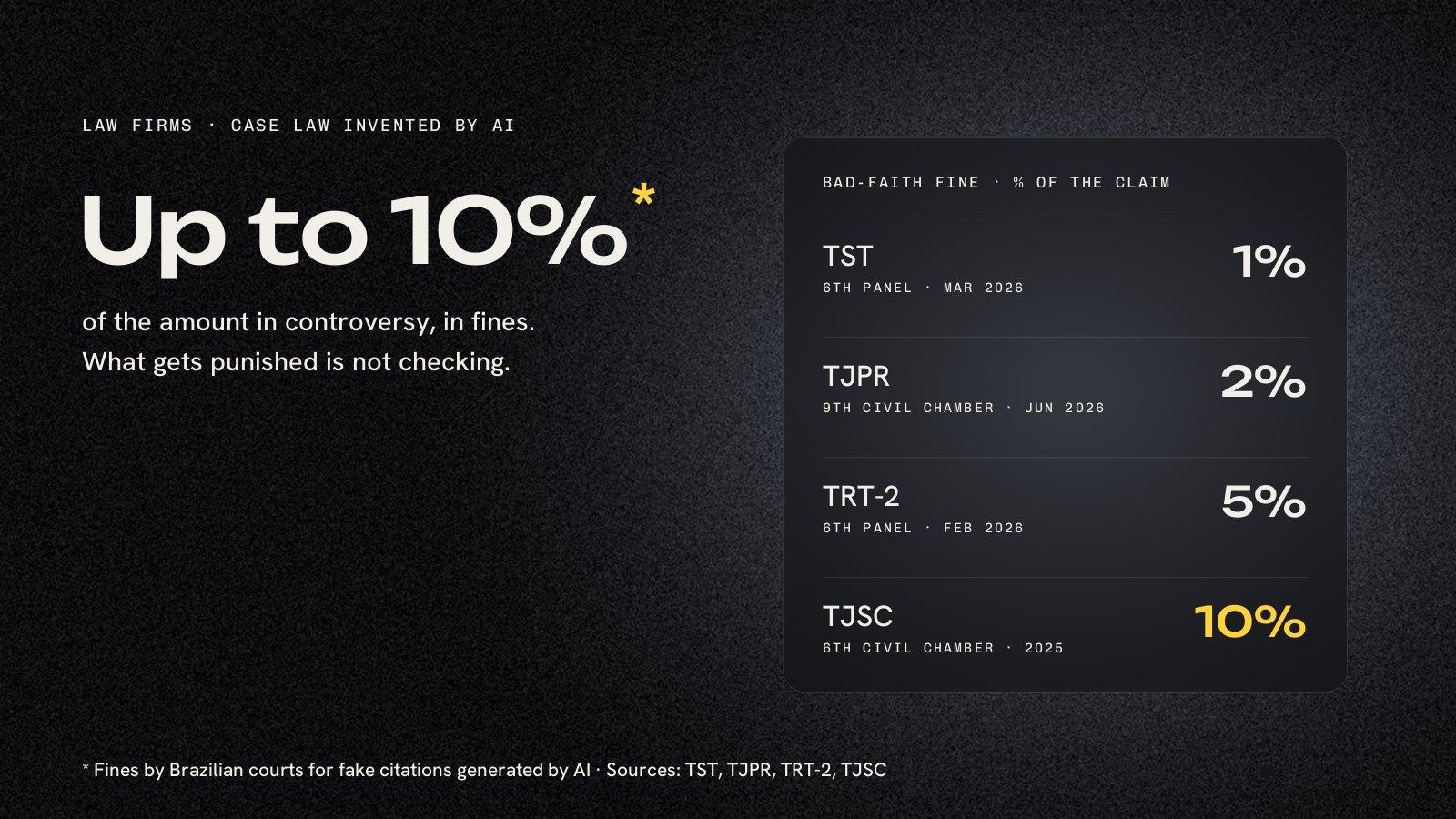
- Brazilian courts, from the Supreme Court (STF) to federal trial courts, have been fining lawyers for citing nonexistent case law and statutes generated by AI, with fines of 1% to 10% of the amount in controversy.
- What Brazilian courts punish is not the use of AI: it is presenting in court a citation the lawyer did not check.
- Blaming the intern or the tool does not set the fine aside, because responsibility for a filing lies with the lawyer who signs it.
- The hardest error to catch is the real citation that does not say what the filing claims, and it only shows up when someone opens the full text of the decision.
On September 21, 2026, the Santa Catarina Court of Justice (TJSC), a Brazilian state court, unanimously upheld a fine for bad-faith litigation against a party that cited a passage attributed to the STJ (Superior Court of Justice) that did not match the actual decision. It is one more case on a list that grows every month in Brazil, from the STF (Brazil's Supreme Court) to federal trial courts.
What these cases have in common is not the use of AI. It is the lack of checking.
The cases that have already ended in fines
| Court | When | What happened | Consequence |
|---|---|---|---|
| STF (Justice Cristiano Zanin) | May 2025 | Filing with precedents that could not be located and a binding precedent (súmula vinculante) cited out of context | Bad-faith fine, double court costs and a referral to the Brazilian Bar Association (OAB) |
| 2nd Federal Trial Court of Londrina | June 2025 | Articles of law and a "Procedural Law of Time" ("Lei Processual do Tempo") that do not exist | 20 times the monthly minimum wage and a referral to the Bar (OAB-PR) |
| TJSC, 6th Civil Chamber | 2025 | Fake case law in an appeal; the lawyer admitted using ChatGPT | 10% of the amount in controversy and a referral to the Bar (OAB-SC) |
| TRT-2 (Regional Labor Court, São Paulo), 6th Panel | February 2026 | At least eight fake precedents; the lawyer blamed the interns | 5% of the amount in controversy and a referral to the Bar (OAB-SP) |
| TST (Superior Labor Court), 6th Panel | March 2026 | Nonexistent precedents and falsified data in a response brief | 1% for the company, 1% for the lawyer and referrals to the Bar and to the Federal Prosecution Service (MPF) |
| TJPR (Paraná Court of Justice), 9th Civil Chamber | June 2026 | STJ precedent "fabricated" by AI | 2% of the amount in controversy and a referral to the Bar (OAB-PR) |
| TJSC, Group of Civil Law Chambers | September 2026 | Passage attributed to the STJ that was not in the decision | Bad-faith fine upheld |
The STJ has also imposed a fine of 10% of the amount in controversy, and the TSE (Superior Electoral Court) has recorded at least nine such rulings since 2025, according to a survey by Conjur, a Brazilian legal news outlet.
What Brazilian courts are punishing
None of these decisions punishes the use of AI. They punish something old: presenting false information to the judge. Brazil's Code of Civil Procedure requires parties to state the facts truthfully (art. 77), and a filing is the responsibility of whoever signs it.
Recommendation 001/2024 of the OAB Federal Council says the same in other words: everything the AI generates must be reviewed in full before it goes to court, and "excessive reliance on AI tools is inconsistent with the practice of law".
The fine does not come from using AI. It comes from signing a citation nobody checked.
Blaming the intern does not work
In the TRT-2 case, the lawyer attributed the fake precedents to "the firm's body of interns". The reporting judge answered that appearing in court is an act reserved to the lawyer, and the fine was 5% of the amount in controversy.
The same logic applies to the tool. Saying "it was the AI" changes nothing, because the one who chose to use it, and the one who signed, was the lawyer. The Brazilian Bar also assigns partners and managers the duty to supervise the use of AI by associates, interns and assistants.
The fine is not the only risk
Almost every decision orders a referral to the Bar. Brazil's Statute of the Legal Profession treats as a disciplinary offense distorting the content of a legal provision, a scholarly citation or a court decision in order to mislead the judge (art. 34, XIV).
When the referral also goes to the Public Prosecutor's Office, as in the TST case, a criminal discussion opens. Conjur points to the offenses under debate: ideological falsehood (false statements in a document) and use of a false document.
The hardest error to catch
Invented case law is the most famous error, but it is not the most dangerous. A case number that does not exist is found out in one search.
The hard error is the real citation that does not say what the filing claims. The case exists, the court exists, but the passage was distorted, comes from the dissenting opinion or deals with a different situation. That is what happened in the September TJSC case. Stanford researchers call this error misgrounding: the source is real, but it does not support the claim.
A paid tool does not solve it. The Stanford study published in 2025 tested AI legal research tools and found incorrect or poorly grounded answers between 17% and 33% of the time. A checker that only confirms the number exists lets this error through.
How to check every citation
One minute per citation settles most cases:
- Does the case exist? Search for the number on the court's website, not on an aggregator and certainly not in the AI itself.
- Is the passage there? Open the full text of the decision and look for the quoted sentence. If it is not there, the citation comes out.
- Does it say what the filing says it says? Read the surrounding paragraph. Check that it comes from the majority opinion and deals with the same situation.
- Does it still stand? Look at the date and whether the holding has been superseded.
- Be suspicious of the perfect headnote. A headnote that answers your argument exactly, in your own words, deserves the most careful check.
If the error has already been filed
Correct it before the opposing party or the judge points it out. Acknowledging the error in a filing and replacing the citation is the safest path. Trying to explain afterward, or shifting the blame, as at TRT-2, tends to make things worse.
What a law firm needs to have
Avoiding these cases does not depend on banning AI. It depends on three things: a clear checking rule, a team trained to apply it and a record of who was trained and when. Supervision without a record is just a claim.
That is the work of Elev's AI for Law Firms inside law firms: training the team on its own cases, putting the checking rule in place and keeping the firm's base of filings and arguments tested every month. If you want to know how your team uses AI today, talk to us.
Sources
- TJ-SC upholds fine for use of fake case law generated by artificial intelligence, JuriNews, September 2026.
- Company and lawyer sanctioned for possible use of AI with fake case law citations, TST, March 2026.
- Lawyer for party sanctioned for bad faith blames interns for use of AI, Migalhas, February 2026.
- TJ/PR finds bad faith and fines lawyer over decision "fabricated" by AI, Migalhas, June 2026.
- TJSC fines appellant for fake case law generated by AI, TJSC.
- News item on the decision of the 2nd Federal Trial Court of Londrina, TRF4 (Federal Regional Court of the 4th Region), June 2025.
- Zanin finds bad faith and rejects AI-written filing with fake precedents, Migalhas, May 2025.
- Lawyers' AI errors irritate courts and open the risk of criminal liability, Conjur, March 2026.
- Recommendation No. 001/2024, OAB Federal Council.
- Hallucination-Free? Assessing the Reliability of Leading AI Legal Research Tools, Magesh et al., Stanford, Journal of Empirical Legal Studies, 2025.
Frequently asked questions
Can lawyers in Brazil use AI to draft court filings?
Yes. Neither the Brazilian Bar Association (OAB) nor the courts prohibit it. Recommendation 001/2024 of the OAB Federal Council requires human supervision and a full review of everything the AI generates before it is presented in court. The fines fall on those who skipped that review.
What is the fine in Brazil for citing fake case law generated by AI?
In recent cases, fines for bad-faith litigation ranged from 1% to 10% of the amount in controversy, plus fixed fines, such as 20 times the monthly minimum wage at a federal trial court in Londrina. The court almost always also sends a referral to the Bar and, in some cases, to the Public Prosecutor's Office.
If an intern wrote the filing, is the intern to blame?
Not before the court. At TRT-2, a regional labor court in Brazil, the lawyer attributed the fake precedents to the firm's interns and was fined 5% of the amount in controversy, because appearing in court is an act reserved to the lawyer. The Brazilian Bar also assigns partners and managers the duty to supervise the team's use of AI.
Does a paid legal AI tool eliminate the risk of fake citations?
No. A Stanford study published in 2025 tested paid legal tools and found incorrect or poorly grounded answers between 17% and 33% of the time. The tool helps; checking the citation remains the lawyer's job.
How do I verify that a court decision cited by AI actually exists?
Search for the case number on the court's website, open the full text of the decision and locate the quoted passage. Then check whether the passage supports the argument in the filing, whether it comes from the majority opinion and whether the holding still stands. A headnote found only in an AI answer does not count as a source.
Get the next articles.
One email when a new article is out. No sales sequence, no made-up schedule.
Published on September 23, 2026