
66% of Brazilian lawyers use AI on personal accounts: the risk
Brazilian Bar and Stanford survey: two in three lawyers use AI on a personal or mixed account. The confidentiality risk and what a law firm should do.

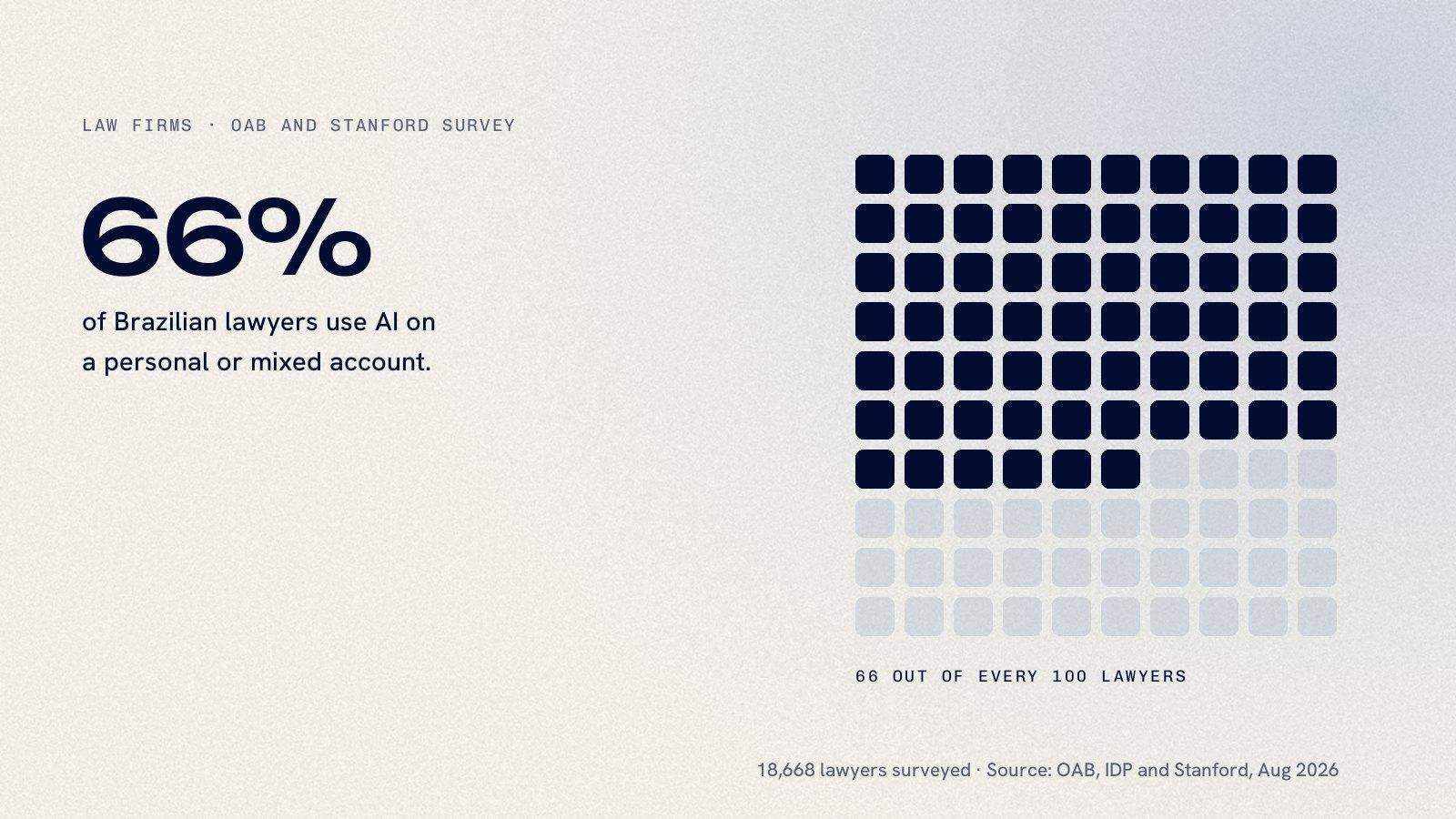
- A survey of 18,668 lawyers by the Brazilian Bar Association (OAB), IDP and Stanford University, presented on August 24, 2026, shows that 66% use AI on a personal or mixed account.
- On a personal account, the contract belongs to the person, not to the law firm: the firm does not control what goes in, cannot see the history and cannot delete anything when someone leaves.
- Attorney-client confidentiality is the lawyer's duty, not the tool vendor's, and breaching it is a disciplinary offense under Brazil's Statute of the Legal Profession.
- The solution is not to ban AI: it is a firm account, a written rule on what can go in, a written agreement with the client and a trained team.
Two in three Brazilian lawyers use artificial intelligence on a personal or mixed account. The number comes from the largest survey ever conducted on AI in the legal profession in Brazil, presented by the Brazilian Bar Association (OAB) on August 24, 2026. For law firms, it is a confidentiality risk that is already happening, and almost always outside the partners' field of view.
What the Brazilian Bar and Stanford survey showed
The survey "AI Governance and Digital Legal Practice" ("Governança de IA e Prática Jurídica Digital") was conducted by the OAB Federal Council, by IDP (a Brazilian law school) and by the Deliberative Democracy Lab at Stanford University. About 250,000 lawyers were invited and 18,668 responded.
The numbers that matter most to anyone who runs a law firm:
- 66% use AI on a personal or mixed account, mixing personal and professional use.
- 77% of those who use AI named ChatGPT.
- 53% pay for a version of the tool.
- 24% use it one to two hours a day.
According to the OAB, the results will serve as the basis for a formal rule (provimento) of the Federal Council on the use of AI in the legal profession. In other words: the rule that is coming will start from this picture.
What is the problem with a personal AI account
The problem is not the tool. It is who is in charge of it.
The contract belongs to the person, not to the law firm. When a lawyer creates a personal account, the lawyer is the one who accepts the terms. The firm does not know what was pasted in there, cannot see the history and cannot delete anything when that person leaves.
Training may be turned on. On OpenAI's personal plans, Free, Plus and Pro, conversations can be used to train the models by default, unless the user turns the option off. At Anthropic, users on Claude's personal plans choose whether to allow training, and those who allow it have their data kept for up to five years. On both companies' business plans, the default is not to train. On a personal account, protection depends on each lawyer having changed the right setting.
The data does not stay in Brazil. OpenAI offers data storage in regions such as Europe, the United States, Japan and India, only on business plans. Brazil is not on the list.
Attorney-client confidentiality belongs to the lawyer. It does not pass to the tool vendor when the document is pasted into the conversation.
Brazil's Statute of the Legal Profession treats breaching attorney-client confidentiality without just cause as a disciplinary offense (art. 34, VII). And Brazil's General Data Protection Law (LGPD) provides for a fine of up to 2% of revenue, capped at R$ 50 million per violation, for anyone who processes personal data without the required safeguards.
What the Brazilian Bar already recommends
Recommendation 001/2024 of the OAB Federal Council, approved in November 2024, already answers a good part of the questions:
- Confidentiality: special care when entering data that could make the client identifiable.
- Choice of tool: diligence to ensure the vendor protects the information and allows the data not to be used for training.
- Supervision: "excessive reliance on AI tools is inconsistent with the practice of law". Partners and managers must supervise use by associates, interns and assistants.
- Client: put in writing, before starting, the intention to use AI, with the purpose, risks, security measures and human review.
One detail of the survey stands out. After debating the subject in groups, lawyers' support for the obligation to inform the client fell from 48.7% to 37%. The OAB recommendation, however, already advises this written agreement. Those who leave it until after the formal rule may have to redo the work in a hurry.
Banning AI does not work
The most common reaction of a partner who discovers these numbers is to ban the use. It does not work. According to OAB-SP, the Bar's São Paulo chapter, three in four lawyers already use AI at work; banning it only pushes the use onto the phone, where nobody sees it.
The path that works is to bring the use inside, with a rule.
What a law firm should do
- Find out who uses what. A simple map: which tools, on which account, with what type of document.
- Have a firm account. A business plan, contracted by the firm, with training turned off and control over who comes in and who leaves.
- Write down what can go in. Which documents can be used, when to anonymize, what never leaves the firm's system.
- Put it in writing with the client. As Recommendation 001/2024 advises, in writing and before using it.
- Train the team on real work. Using the right account, checking citations and knowing what to do when something goes wrong.
- Keep a record. Who was trained, when and on what. If the firm ever needs to explain its use of AI, this record is part of the defense.
That is where Elev's AI consulting for law firms begins: an assessment that shows how many people on the team use AI out of sight and with what type of data. You come away with a number and decide what to do with it. Talk to us.
Sources
- Advocacia 4.0: OAB opens forum on artificial intelligence with survey that heard 18,600 professionals, OAB, August 2026.
- Survey of 18,000 lawyers reveals opinions on the use of AI in the legal profession, Correio Braziliense, August 2026.
- OAB Federal Council announces national plan to integrate artificial intelligence into the legal profession, OAB, June 2026.
- Three in four lawyers use artificial intelligence at work, OAB-SP, March 2026.
- Recommendation No. 001/2024, OAB Federal Council.
- Statute of the Legal Profession, Law 8,906/1994 and LGPD, Law 13,709/2018.
- How your data is used to improve model performance and data residency in ChatGPT, OpenAI.
- Updates to the consumer terms, Anthropic, August 2025.
Frequently asked questions
Can a lawyer put client data into ChatGPT?
The Brazilian Bar Association (OAB) does not prohibit the use of AI, but its Recommendation 001/2024 calls for special care when entering data that makes the client identifiable and for diligence in choosing a tool that protects the information and allows the data not to be used for training. On a personal account, the law firm does not have those guarantees by contract.
Does the paid version of ChatGPT solve the confidentiality problem?
Not necessarily. The Free, Plus and Pro plans are personal accounts: conversations can be used to train the models by default, unless the user turns the option off. Business plans, such as Business and Enterprise, do not use the data for training by default and stay under the law firm's control.
Do I need to tell my client that I use AI?
Recommendation 001/2024 of the Federal Council of the Brazilian Bar Association (OAB) advises putting in writing to the client, before starting, the intention to use AI, with the purpose, risks, security measures and human review. The OAB is preparing a formal rule on the subject, based on the survey conducted with Stanford.
Is the Brazilian Bar going to ban lawyers from using AI?
That is not what the signs point to. The National Plan for Integrating AI into the Legal Profession, announced by the Brazilian Bar Association (OAB) in June 2026, speaks of responsible use, training and good practices. What is under discussion are rules on confidentiality, human supervision and transparency.
What is the difference between a personal and a business AI account?
On a business account, the contract belongs to the law firm: it defines who uses it, sees the history, shuts off access for those who leave and has guarantees that the data does not train the model. On a personal account, each lawyer accepts the terms on their own, and the firm is left with no control at all.
Get the next articles.
One email when a new article is out. No sales sequence, no made-up schedule.
Published on September 23, 2026